Policies
Kono Bicycle Project
Health and Safety Policy
Health and safety is of primary importance to our project. We ensure that:
- Beneficiaries learn to ride safely
- Bicycles are well maintained and safe to ride
- Volunteers work in a safe environment
Project volunteers, beneficiaries and our community partners are made aware of the following Health and Safety guidelines in the following ways:
- Induction workshop for new bicycle library members
- Website
- Bicycle repair and maintenance workshop
- Individual and group support when the need is identified.
Making sure that this policy informs all aspects of our work is a shared responsibility between the project director, the project leader, community members, partner agencies, parents and beneficiaries.
LEARNING TO RIDE SAFELY
Before riding a bike:
- Attend an induction workshop
- Adjust saddle and handle bars
- Check tyre pressures and tyre condition
- Check brakes and gears
- Check for loose nuts and bolts
- Check condition of chain
When riding a bike:
- Wear helmet
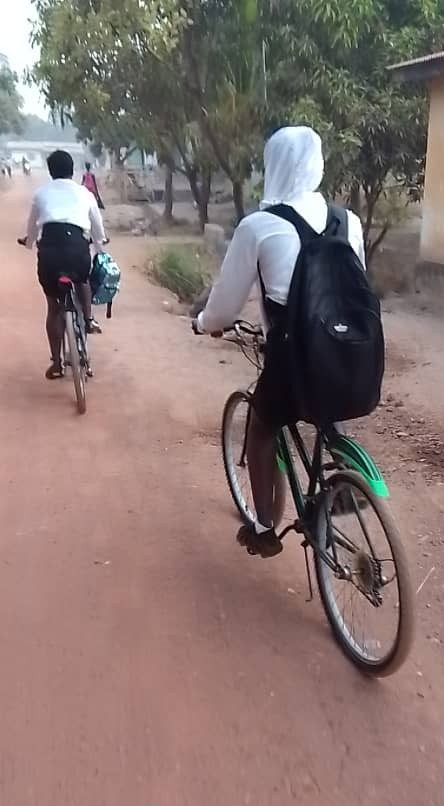
- Wear bags on back (not hanging from handlebars).
- How to get on and off a bike
- How to steer a bike
- How to change gears
- How to brake safely
Road conditions:
- Riding on rough and uneven roads
- Riding in bad weather
- Riding in traffic
Bike safety and security:
- What to do if you have an accident
- What to do if your bicycle breaks
- How to lock a bike securely
- What to do if someone tries to take your bike from you
- What to do if your bike is stolen
BICYCLE MAINTENANCE AND REPAIR
All our bicycles are:
- Sourced from reputable and reliable local bike stores
- Checked and serviced during school holidays
- Spare parts are bought as new from local bike stores
- Beneficiaries contact the project leader when repairs are necessary.
- Repairs are carried out by the project mechanic or local bicycle mechanics.
- If a bicycle is assessed as unsafe to ride, it will be taken off the road until the necessary repairs can be made.
- A Village Bicycle Project mechanic provides bicycle repair and maintenance training for beneficiaries, project volunteers and local bike mechanics.
- A record of health and safety issues is kept in the project log book, including a record of any bicycle accidents.
- The log book is to be discussed monthly, or as and when the need arises.
- This Health and Safety policy is to be reviewed annually, or as and when the need arises.
Dr Chris Jarrell
05/02/2026
Kono Bicycle Project
Safeguarding Policy
(Sierra Leone Children’s Protection Act, 2025)
The purpose of this policy statement is to protect from harm children and young people who are beneficiaries of the Kono Bicycle Project.
- The term ‘safeguarding’ describes the broader preventative and precautionary procedures that need to be in place to protect children and young people from any potential harm,
- If we learn or suspect that harm is taking place it is our responsibility to act on this by passing our concerns on to safeguarding professionals in the community or partner organizations, as soon as is reasonably possible.
What is harm?
The physical, sexual or emotional abuse, coercion or neglect, of children and young people. Examples of harm to children and young people are:
- Inappropriate parenting or inappropriate relationships with family members, friends of the family, the wider community, and teachers. Domestic and school violence or sexual abuse, as well as physical or emotional abuse or neglect.
- Other children and young people (bullying, abuse). This can happen in any setting working with children and young people.
- Themselves (self-harm, risky behavior, alcohol and drug abuse).
- Coercing children and young people into inappropriate relationships or behavior as a condition of receiving a service.
- Unsafe activities and environments, such as accidents on the roads.
- This safeguarding policy should be used to create an environment where there is no negligence or unnecessary exposure to avoidable risks.
Creating a safe environment.
- Where risks do need to be taken, we should ensure that they are calculated, carefully managed and communicated to both children, young people, their parents or carers, teachers and volunteers.
- This policy is not designed to stifle activities, eradicate all spirit of adventure from our projects or to replace the trust between the people in our communities and partner agencies with that of suspicion.
Adopting a child centred and young person centred approach.
- Children and young people should be involved in the development and implementation of risk assessments because they often know best when they feel safe and what can be done to prevent harm.
- Involving children and young people will help to promote an environment where their welfare is paramount and contribute to a culture of honesty and openness.
- It will also help a child or young person recognise that their voice and views are important and valued which in turn, will mean they are more likely to feel able to raise any worries or concerns.
Safeguarding children and young people is everybody’s business.
For this policy to work effectively:
- It should be visible and available for all to see and inspect.
- Training and awareness raising is required for all volunteers, parents and beneficiaries, and should include input from a safeguarding professional.
- Recruitment of volunteers should include a safeguarding risk assessment.
- Activities should be risk assessed with reference to what harm we are protecting children and young people from in any specific situation, e.g. coercion when shopping for bicycles or inappropriate physical contact when running orientation workshops.
This policy is:
- An edited version of the Conforti Community Aid Children’s Organisation (Freetown) Safeguarding Policy.
- Edited with reference to the National Society for the Prevention of Cruelty to Children (UK) ‘Guidelines on How to Write a Safeguarding Policy’.
- To be reviewed annually, and sooner if the need arises.
Dr Chris Jarrell, 17.02.26
Kono Bicycle Project
Privacy Policy
Generated privacy notice - charity and voluntary
Kono Bicycle Project customer privacy notice
This privacy notice tells you what to expect us to do with your personal information.
- Contact details
- What information we collect, use, and why
- Lawful bases and data protection rights
- Where we get personal information from
- How long we keep information
- How to complain
Contact details - Email
What information we collect, use, and why
We collect or use the following information to receive donations or funding and organise fundraising activities:
- Names and contact details
- Donation history
We collect or use the following personal information for service updates or marketing purposes:
- Names and contact details
- Donation history
- Website and app user journey information
- Records of consent, where appropriate
We collect or use the following personal information for dealing with queries, complaints or claims:
- Names and contact details
- Correspondence
Lawful bases and data protection rights
Under UK data protection law, we must have a “lawful basis” for collecting and using your personal information. There is a list of possible lawful bases in the UK GDPR. You can find out more about lawful bases on the ICO’s website.
Which lawful basis we rely on may affect your data protection rights which are set out in brief below. You can find out more about your data protection rights and the exemptions which may apply on the ICO’s website:
- Your right of access - You have the right to ask us for copies of your personal information. You can request other information such as details about where we get personal information from and who we share personal information with. There are some exemptions which means you may not receive all the information you ask for. Read more about the right of access.
- Your right to rectification - You have the right to ask us to correct or delete personal information you think is inaccurate or incomplete. Read more about the right to rectification.
- Your right to erasure - You have the right to ask us to delete your personal information. Read more about the right to erasure.
- Your right to restriction of processing - You have the right to ask us to limit how we can use your personal information. Read more about the right to restriction of processing.
- Your right to object to processing - You have the right to object to the processing of your personal data. Read more about the right to object to processing.
- Your right to data portability - You have the right to ask that we transfer the personal information you gave us to another organisation, or to you. Read more about the right to data portability.
- Your right to withdraw consent – When we use consent as our lawful basis you have the right to withdraw your consent at any time. Read more about the right to withdraw consent.
If you make a request, we must respond to you without undue delay and in any event within one month.
To make a data protection rights request, please contact us using the contact details at the top of this privacy notice.
Our lawful bases for the collection and use of your data
Our lawful bases for collecting or using personal information to receive donations or funding and organise fundraising activities are:
- Consent - we have permission from you after we gave you all the relevant information. All of your data protection rights may apply, except the right to object. To be clear, you do have the right to withdraw your consent at any time.
Our lawful bases for collecting or using personal information for service updates or marketing purposes are:
- Consent - we have permission from you after we gave you all the relevant information. All of your data protection rights may apply, except the right to object. To be clear, you do have the right to withdraw your consent at any time.
Our lawful bases for collecting or using personal information for dealing with queries, complaints or claims are:
- Consent - we have permission from you after we gave you all the relevant information. All of your data protection rights may apply, except the right to object. To be clear, you do have the right to withdraw your consent at any time.
Where we get personal information from
- Directly from you
How long we keep information
Personal information will be kept for 5 years.
How to complain
If you have any concerns about our use of your personal data, you can make a complaint to us using the contact details at the top of this privacy notice.
If you remain unhappy with how we’ve used your data after raising a complaint with us, you can also complain to the ICO.
The ICO’s address:
Information Commissioner’s Office
Wycliffe House
Water Lane
Wilmslow
Cheshire
SK9 5AF
Helpline number: 0303 123 1113
Website: https://www.ico.org.uk/make-a-complaint
Last updated
12/04/2026